Saturday, October 3, 2015

Part #1: Do The Following and You Will Succeed as an ESL Teacher - Reported Speech

    EDITORS NOTE: This is the first of a five-part article: "Do The Following and You Will Succeed as an ESL Teacher" Part 1 Reported speech required. 2. Model 
politeness. 3. Second language only. 4. Use no words they don't know.  5. Contests that challenge.

 People always ask each other to repeat what they have said. Without being nosy (or even with it) people always ask each other what they have heard. The fact is, most of what people say is a repetition of what they had heard or a regurgitation of what they have read and learned. This sharing of other people's data is commonly referred to as "reported speech."


     No one can be fluent in English as a Second Language until they have mastered the art of gossip, asked others to repeat what was not heard or understood, shared information, or clarified what they have heard. Of course it is incumbent on the native English speaker to rephrase when repeating information to a student, but for the gymnastics of English grammar and language arts, there is nothing better for the student than to report the speech they have heard and practice shifting gears in English discourse. 


     For native English speakers and ESL students alike, there is no better way to make sure you understand instructions and directions than to repeat back what you have just heard and get affirmation or correction. The listener may be victim to mumbling, unknown lexicon, or simply distracted by background noise, or even handicapped by a medical condition such as hearing loss or tinnitus. In any case, reporting speech is a remedy for non-comprehension. 


     Certainly, in the classroom, there is no better way to get students' undivided attention than to ask them to report what you have asked them or  how they and their classmates have responded. It will keep students on task and paying attention or risk losing face to classmates in discourse by not knowing what they said. Students will judge each other's friendship by how much attention they give to what they said. In all case scenarios, the teacher holds the ace and can draw the card when necessary to win over the class; it sure beats scolding or punishing a student for being inattentive. A losing situation turns into a prime moment to learn. Furthermore, interrupting students engaged in private classroom chatter brings the errant students back on task.


     ESL teachers must use reported speech with their classes or they can risk kissing their students' attention "goodbye" and losing control of a class. Once that happens, the teacher may never find a way back into the driver's seat without a class of back-seat wiseguys questioning everything the teacher does. Reported speech always acts as a tool to revision and review in the classroom, in real time, before the culmination of class when finding out what your students have learned may be too late. 


There are four types of reported speech, each with its own set of corresponding grammar.


 1. Reported Statement - A sentence is reported thus:

 T: I like apples.What did I say?
 S: You  said you like apples.


 2. Reported Yes/No Question - A question with a "yes" or  "no" answer. For example:

 T: Do you ride a bicycle? What did I ask? 
 S: You asked if I ride a  bicycle.

 3. Reported Wh-question -A question that is answered with    information, like this:

 T: Where do you live? What did I ask? 
 S: You asked where I live.

 4. Reported Imperative - A command or request:

 T: Stand up! What did I say?
 S: You told me to stand up.

 T: Please stand up. What did I say?
 S: You asked me to stand up.  

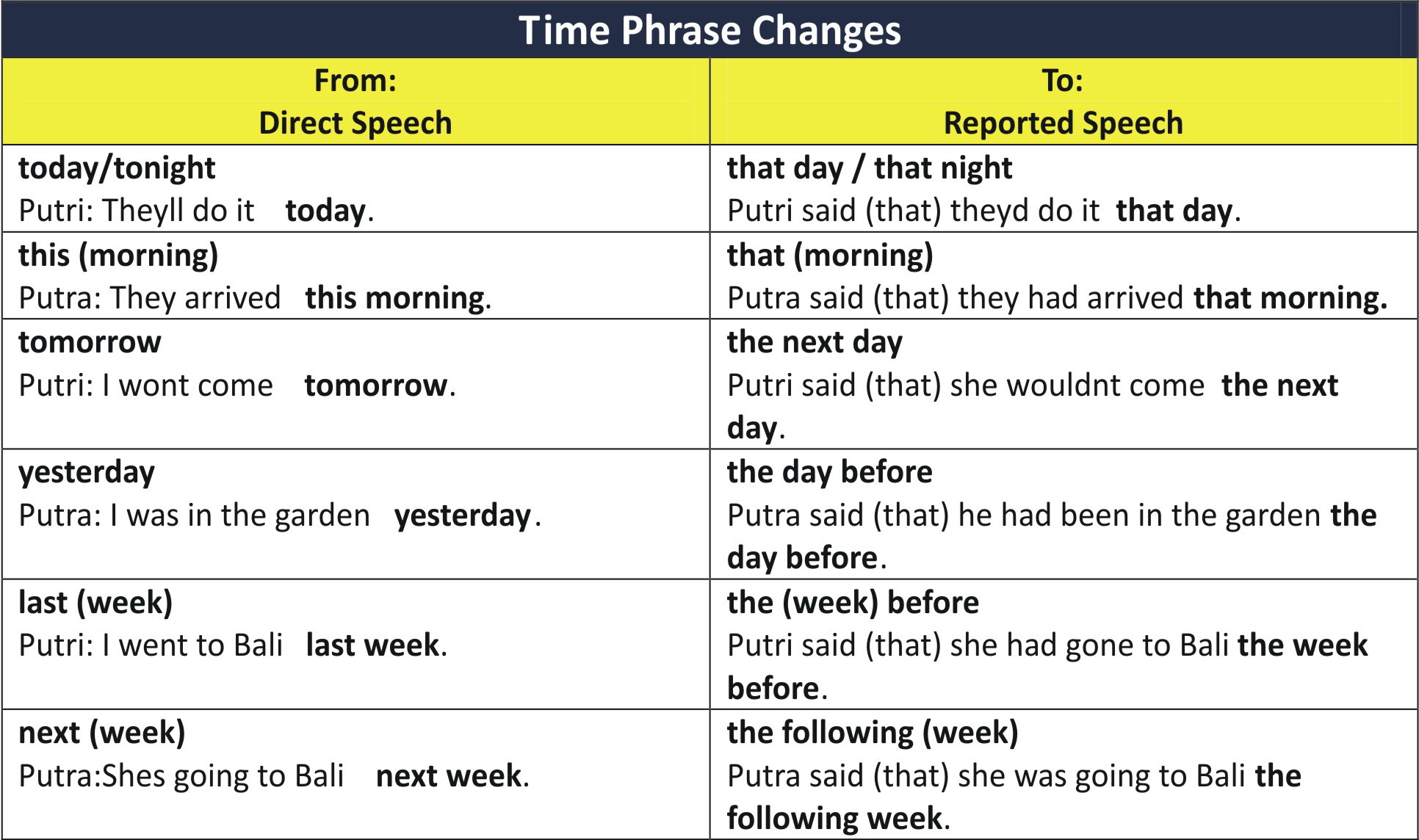
Did you notice that all the reported answers are in the present tense? I do this for a first year ESL student who has not learned other tenses besides the present and present continuous. At a higher level, students can be challenged with the tense shift (see chart below) and special time phrase (see that chart below, too.)

You can Google "Reported Speech" for dozens of level-specific exercises and other details. However, if you use the basic approach to reported speech from day one in your class, you will save yourself a lot of grief and give the students the gift of discourse. 

There is a contest for this, as there is for every English detail you share with your students:
1. Divide the class into two or three teams (or individuals). 
2.Give each student a letter (A, B, C, etc.)
3. Write (or say) a direct speech sentence, question, or imperative.
4. Give the students one minute to prepare their reported answers.
5. After a minute, randomly call out a letter, like "A."
6. The "A" students go to the board and write their reported speech answer.
7. They are listed in the order they sit back down.
8. Go over the answers and assign points for the winner, 3, 2, 1 point or none. 
9. Repeat the process with another direct speech sentence or question.
10. The team with the most points at the end of the contest is the winner. Reward the students. 


[EDITORS NOTE: This has been Part #1 of a five-part article "Do The Following and You Will Succeed as an ESL Teacher." Part # 2-  Model Politeness  #3 Second language only, #4- Use no words they don't know, and #5 - Contests that challenge are to follow. ]


Follow my posts at: https://www.facebook.com/eeodbt

Tuesday, September 22, 2015

The Readers Theater that was Killed by Teachers

  I love the workshops and in-service training I occasionally do in Taichung public schools, but not when the two are mixed as they were at Shuang-Wen Middle School yesterday. 
     I was told that it would be a workshop for students trying out their Readers' Theater presentation. I was expecting to work with the students on delivery and make suggestions. It started out that way. My wife and I took a taxi to the school in Da-Li. We were met at the gate by a student escort. He was very friendly. I asked him if he was in the Readers' Theater troupe and he said 'yes.' I asked him the name of the skit and he said "The Frog Who Became Emperor." I told him that, In the USA, we have a skit called "The Pig who Became President" and he laughed all the way up to the workshop room, even sharing the joke with his classmates and teacher.

     After greeting the three or four teachers and seven students, I listened and then gave a few suggestions. Then, one teacher spoke to my wife and asked her to tell me to stop talking until others came. We assumed the others were students, but there were another fifteen teachers who entered and sat around the u-shaped tables. The children were asked to repeat their skit. Then, the Taiwanese teachers attacked and criticized  them. The children's faces turned solemn after the laughter they exhibited with me earlier, and they listened to the teachers put in their two-cents and berate their performance. 

     I was left to whisper with my wife wondering when the teachers were going to stop talking. When was I going to be asked again to workshop with the kids? For more than an hour, I sat. Once, the gentleman teacher who, I learned, was the new coordinator of the readers' theater initiative (the very pregnant teacher who did so well last year organizing a contest victory for the kids was on maternity leave) had the audacity to approach me and ask how a particular sentence in the script should be intoned. The whole script was in need of intonation modification but directly with the students, not with the face-saving coordinator.

     
     In fact, the script, for which the students had very basic body language or acting, was vague at best, for a plot that made no sense. It made me wonder: where on earth they had found it? My wife checked on Google and found a video of a Jewish westerner who had adapted the story from a western approximation of a 'classic Chinese story' not found anywhere in Chinese history. The moral, "Never give up," had nothing to do with the plot. For the life of them, not one of the twenty Taiwanese teachers could identify the Chinese idiomatic expression that tales from Chinese history usually moralize. 
     With plot twists like the alien birth of a frog to human parents, a frog who could predict the future, a frog that swallows hot coals to spit heat, a frog that disguises himself as a stranger to catch a ball so as to marry the princess who he then reveals his frog-ness to, and the emperor who knows the frog's secret in the line before the frog actually tells him (perhaps clairvoyant, too) the secret that wearing the cloak will give him eternal life, without explaining the side effects of losing his emperor-hood to the frog who then becomes the new emperor. This is the moral? Never give up? I gave up.
     At 2:45, fifteen minutes before my wife's cousin was to pick us up and get us home, the Taiwanese cache of teachers asked me to comment, and so I did. I told them that the children were saddled with a non-comprehensive story that they couldn't get into for lack of coherence and they would surely lose the contest this year unless there was major surgery done on it. 

Tuesday, September 8, 2015

It Won't Work Ch. # 10 Excerpt: Eyewitness to 911

Once in school, he moved his time card to the in-box and proceeded to his first class 7:52; forty-two minutes later, to the teachers’ cafeteria he would go for another cup of coffee and a buttered roll until 9:21 am; period three. He cleaned the chalk board and headed over.
8:51 am, he was standing at the counter about to pay Carol when he overheard the radio that stayed on all day, WINS 1010 news station:
“A plane has just crashed into the World Trade Center,” the reporter said. Carol and Emerson gave an ear.
“What happened?” asked Emerson as he poured milk into his coffee cup.
“An airplane flew into the Trade Center,” she replied nonchalantly, taking his change and ringing him up.
“A big plane?”
“They say a private plane.”
“Hope no one inside got hurt.”

READ THE EXCERPT HERE:
http://iwwnovel.blogspot.tw/2015/09/it-wont-work-ch-10-excerpt-eyewitness.html