Friday, January 26, 2018

Excerpt: "Grievances" from the novel "Life's Progressive Movement"


If he had kept his mouth shut in class that day, it would have been a pretty good day. It started out with him not knowing what he would be teaching, if anything, at Murrow Summer High School. He reported to the school as he was told, and made him visible so his supervisors, Mr. Hamm and Mr. Burger could find him. Mr. Burger did and told Johnny he would be incorporated into the English Language Academy (ELA) core and paired with another teacher.
      He went upstairs at eight thirty to the room originally assigned him in the huge new Brooklyn school to find a lone student still sitting there; no one had told the student that the class was cancelled. At about eighth forty-five, at Mr. Hamm’s office on the second floor, Mr. Jonathan Emerson Davinsky was told he would be assigned temporarily to team teach an ELA class. Mr. Hamm walked him to the classroom, said a few words privately to the woman teaching inside and motioned Emerson to go in.
      There were perhaps fifteen students in the class, all black or Latino, a few Eastern Europeans, all with resentful attitudes and bored with whatever the teacher was doing; she was reading aloud “A Dream Deferred” poem by Langston Hughes. Emerson found his seat in the back of the room and blurted out that he knew of another good poem by Langston Hughes. His team teacher, hands plastered on her desk, leaned over. “Sounds like you would like to read it,” she said. He did so without a rise from the students who groaned and kept their heads on their desks.
      He initiated a reading of A Raisin in the Sun. He found the students reluctant to take parts. He took the role of one character, two students took other roles, and his colleague read the stage directions. He and his colleague stopped periodically to explain the text or draw out opinions from the students. He was able to get the students interested by his heart-felt reading. They began to pick up on the plot of the drama and character types.
      Just before the period ended, while they were reading, for no apparent reason, one male student yelled out “Fuck.” Emerson should have said nothing but instead he admonished the student for cursing in class. “Do you even know what the word really meant?” He didn’t answer. Taking a minute, Emerson explained the history of the British naval rule prohibiting alcohol or women aboard ship and spelled out “for unlawful carnal knowledge” on the blackboard.
      The students, street savvy, had heard something that interested them and listened up. With everybody’s attention perked, they went back to reading the play until the period ended. He had lit a spark. Then the bell rang.
      After a seven minute break, the students returned slowly to the classroom. He saw that they were losing interest again so he brought some democracy into the classroom. He asked for a vote: “Who wants to continue reading? Who wants to do some writing?” The students whose heads weren’t back on their desks voted to read and so read on they did. A few students interrupted. “Yo dude, we aren’t getting credit for taking this class. Why should we work?” Emerson told them after class to go downstairs to the office and ask about the credits.
      The class reading continued with more students perking up and participating as Emerson and the team teacher elicited opinions about the characters. He reminded his colleague that they could get around to one of the themes of the drama: “heroes” was an obvious choice.
      “Let’s write a ‘T-chart’ comparing the characters in the play, shall we?” He put the students’ responses onto the board alongside parallel responses about characters in The Red Badge of Courage.
      “Writing a composition for the English Regents is easy if you plan it this way,” he said. “You must cull the essence of the story; the theme.” To prove his point, he used an analogy between marijuana, cocaine, and human beings, explaining briefly how they are comparable. He knew his trick was working when one student called out, “Like the essence of ‘cancer sticks’ is nicotine.”
      The class went pretty well after that, much better than it had been going when he was sent in. To encourage the students to study, Emerson said how they all would pass the English Regents so long as they were in the ball park with their written responses.
      “I got a 51% on the Regents,” said one young lady angrily, “and they failed me!”
      “If you can do that well again, we will try to get you up to the passing grade, 55%,” Emerson said. “It will be no problem since you will all be learning a lot in this class and getting 80’s anyway.” He was being encouraging.
      His colleague, now shit-faced in the back of the room because he had showed her up, sat writing feverishly in a notebook. He didn’t know it but she was writing Emerson up in a two-page letter of his “offences” and how he had put her “in distress.” Emerson later found this out.
      He found out he was set up to be embarrassed because of his truthfulness and union activity. It had all started the year before in summer school. After being hand-picked as a master teacher for the flagship English Language Academy team at Edward R. Murrow High School, without his prior consent, he had fulfilled his responsibilities of preparing low-achievers, students who had already failed the old and new English Regents at least once. It was not without difficulty though.
      Thanks to his team teacher, Ms. Berry, a fretting, insecure, middle-aged Jewish divorcee from Brooklyn, the goal of the program was jeopardized by her heavy-handed class control and reluctance to allow Emerson’s input into lesson planning. The unnatural blonde with over-worked steel-wool hair and cheap cosmetic face was an English teacher friend of Mr. Hamm who supervised her, closely, at their home school, John Dewey. Anything Emerson said in class, although stimulating to the students, was compromised and framed by Ms. Berry who was always in fear of losing control of ‘her’ class. She must have reported everything Emerson said in cordial relations with Mr. Hamm
Emerson felt that he and the other ESL/Special Education teachers were fifth wheels through the program’s design; all authority and bookkeeping was entrusted to the English teacher in each team.
By mid-July, just a few weeks into the summer program, Emerson was pulled out of class and summoned to Mr. Hamm’s office.
“I have a letter here, Mr. Davinsky, from a student in your class,” said Mr. Hamm seated low behind a desk borrowed in the summer school office. He adjusted his black-rimmed co-paid option glasses over his enormous disproportionate sun-burnt ears hidden by strands of pepper white hair, his emaciated suited body barely filling the swivel chair that could have seated two of him.
“It says here that you were curing in class; I’m reading verbatim,” he made it clear that he wasn’t releasing the child’s name for fear of recrimination. “This letter will remain in my possession, Mr. Davinsky, not sent to the superintendent’s office if you shape up.” He was giving Emerson one more chance after he was dutifully intimidated.
Emerson spent the rest of that summer stifled in a back seat as Ms. Berry, gleefully, took over most of the class instruction.
At summer’s end, it was clear that most of the students in most of the classes had failed the Regents again. Emerson was shocked to find how liberally the tests were graded. Mr. Hamm and Mr. Burger told the grading committee to “go easy on them” and students’ grades were scrubbed to passing marks by a stroke of an eraser on wrong answers. Students with 45% and less were raised up to 55% while the passing score was lowered from 65% to meet demand. It was a ruse and Emerson didn’t keep quiet about it.
The next year’s summer school program, despite the animosity between Mr. Hamm and Johnny, found him re-assigned to Murrow. Emerson assumed, as did all the master teachers chosen there, to teach ELA again. When he checked in to the school as June ended, Mr. Hamm was there in the hallway seated behind a bridge table where teachers were to pick up their schedules. There was no schedule for him. “I don’t know why,” was all Mr. Hamm said when Emerson asked. “It will be ready the first day of class.”
When classes began the day after Independence Day, Emerson found the blue folder with class rosters in his assigned mail slot. He was given a schedule with one student in period one, none in period two, and one in period three. “How could they make up classes like that?” he thought. It never crossed his mind that he was being set-up to be excessed but that’s what was happening.
After the first day, he sent to the attendance office his live registers yet he was sent back to his classes the next day. “The administration must need time to straighten things out,” he thought. “I must be patient.” He spoke with his colleagues and found that he was not alone given a weird schedule. Some teachers had three classes; some had two. Some had large class rosters, some had small. Some had air-conditioned rooms some, like Emerson, didn’t. No one knew what they would be teaching.
“Let’s give the administration until Friday to get their act together,” Emerson repeated to his colleagues, “and then hold a union meeting in the afternoon to discuss our grievances if they haven’t.” All agreed. Emerson went back to his empty room after the break. He had just gotten comfortable when Mr. Hamm came by; he assumed he visited all rooms as he should. Like he didn’t know and hadn’t himself written the roster, he acted surprised, put his stack of papers down on Emerson’s desk and wrote “KILL” three times on his three class lists before silently leaving.
He walked down the cavernous hallway to fill out the documents that that been left in his mail slot by the payroll secretary. He passed by Mr. Burger’s office. There was a note on his time card from Mr. Burger: “See me.” He went to his office. Feigning sympathy, Mr. Burger spoke:      
“Your classes were cancelled because of low enrollment. You will be excessed from Murrow.”
“But you could reassign me to ELA classes.”
“Not reassigned to ELA; excessed,” he repeated sullenly.
“I will tell my students tomorrow.”
“That won’t be necessary. Don’t come back tomorrow.”
“You have to give me more than one day notice to find another position.”
“No I don’t think so.”
Frantic for summer employment, Emerson walked outside to find a pay phone to call his assistant principal at his home school, Norman Thomas; he was told there was no ESL position in the summer school there. The principal, Ms. Vole, said there wasn’t a position for him there, either, but Ms. Vole advised Emerson to see Ms. May back at Murrow and claim retention rights.
 Emerson walked back in to Murrow and found Ms. May’s office.
“I was told by Mr. Burger not to come in Monday.”
“What? He can’t do that.”
“You go back there right now and clock in.” Emerson did so, passing Mr. Hamm’s office on the way.”
”I thought I told you to leave,” he said angrily confronting Emerson at the time clock.
      “Ms. May said I stay,” Johnny told him. Mr. Hamm huffed off in the direction of Ms. May’s office. Turns out, she had higher authority than Mr. Hamm so the decision stood, however, Emerson still didn’t know what he would be teaching on Monday. At least, he thought, he would get paid for Friday.
“The teachers will be having a meeting in the teachers’ cafeteria at 1:00pm to discuss our problems. I just wanted you to know.
“Will the meeting be for teachers and administrators as well?”
     “It is a UFT meeting but you are welcome to come and spend some time sharing your plan for next week with us.”
He returned to his temporary assignment, in the English bookroom, helping teachers who still hadn’t received textbooks. To everyone’s surprise, Mr. Burger came on the PA saying there would be a rapid dismissal fire drill and a meeting for ELA teachers in the principal’s meeting room immediately after. Emerson strongly believed Mr. Burger had done that to pre-empt their UFT teachers’ meeting at one o’clock.
When they got to the teachers’ cafeteria at one o’clock, Mr. Hamm and Mr. Burger hemmed and hawed about their “plan” for the next week. It was obvious to every teacher there that they had drawn up something on the spur of the moment as damage control to squelch any teacher complaints; they were still unsure of the room assignments, teaching teams, or much else. They said they would come back Monday with a more complete schedule.
The principal’s meeting, as promised, ended at 1:08pm and they left to clock out. Ten of the thirteen ELA teachers then went to meet in the teachers’ cafeteria. The union meeting was held in the teachers’ cafeteria at noon. No union representative had been sent by the UFT to the school so Emerson took the liberty of forming an ad hoc union committee. There were eleven grievances cited by the ten teachers present:

1.     Understaffed security – only two guards and the front door and one at the side; none on the floors.
2.     No Pass System – no provisions made for bathroom passes for students and no pass rules.
3.     Disorganized, scattershot supplies and books – teachers had difficulty getting everything from textbooks to blackboard erasers
4.     Un-cleaned classrooms – trash cans un-emptied, floors unswept
Copy room chaos – no provision for making copies; no master copies of handouts available
5.     Rooms unfit for teaching; broken fans and air-conditioners or none at all. Noise pollution from passing subway trains at opened windows
6.     .Regents marking team – no indication of who will mark the regents
No ELA curriculum – where are the “stations” (videos, audios, workbooks, supplementary reading) so painstakingly designed for the inaugural ELA Summer Academy last year
7.Attendances cards/ roll books- there is no accounting system for students’ grades
Unclear schedule and assignments – teachers did’t know which classes they’d be teaching or even which rooms or number of periods. It was unclear if there would be team teaching or what their responsibilities were.
 Before the meeting ended, Mr. Burger went to the cafeteria and, in front of his colleagues, told Emerson he wanted to see him in his office. Emerson asked for a colleague to accompany him and one teacher, Mr. Mitchell, volunteered.
 When they approached Mr. Burger’s office, Mr. Burger asked who Mr. Mitchell was. “I must warn you, Mr. Davinsky, that sensitive material will be discussed. You may not want anyone else to hear it.” Mr. Mitchell stayed, they were seated, and Mr. Burger took out the two-page hand-written letter from Emerson’s team teacher. She had written some twisted truths and out and out lies painting Emerson as some kind of foul-mouthed pervert.
“I object to the accusations against me,” Johnny blurted out. He was not given a copy of the letter to read.
“Save your comments for the end,” Mr. Burger advised. He went on reading the letter and then asked him, “Do you want to give me a written response?”
“Yes,” he said, “but first I want to see that letter and talk with my union representative.”
      Mr. Burger looked annoyed and wrote down on a pad in front of him “refuse to respond” as he spoke the words aloud.
“This letter will be sent to the superintendent’s office.”
Mr. Mitchell and Mr. Davinsky got up to leave but not before Mr. Hamm and Mr. Burger smilingly took Mr. Mitchell aside and showed him a curriculum lying on the table. Mr. Mitchell smiled back politely, glanced at the material, and left the room with him.
He was distraught from the intimidation and half-truths by his ‘team-teacher’. He stomped outside, unchained his bicycle, and raced home to call the union representative from his home school, Mr. Harry Combs. Combs calmed him down as they discussed the incident that day.
“I want to file charges against Mr. Hamm and Mr. Burger,”  he demanded.
“Let’s get your job back first,” he said.
“The union can’t let them get away with this!”
“What’s more important; doing the right thing or getting your job back?” questioned Harry.
“Doing the right thing; if the union does the right thing, I will get my job back!”
They decided that Emerson should report back to Murrow on Monday for reassignment. If Mr. Hamm and Mr. Burger chose to go through with the charade and make a case out of Emerson, he would respond after being formally charged. Meanwhile, Ms. Vole had made some phone calls and had gotten a temporary position at Clara Barton High School for him.
He regretted saying anything in his temporary ELA class that could have been misconstrued as unacceptable behavior. His job, he felt, as a teacher was to motivate students to learn and prepare to pass the English Regents. He was not a vile, foul-mouthed or mutinous team-player as his vindictive colleague stated. She did not seem “distressed” by his actions as she had stated. He had apologized and wished she had demonstrated more understanding and solidarity. He believed he was singled out and conspired against.
After the summer ended with him shifted around to three different high schools, the last one way out, in a “bad school” on Pennsylvania Avenue in Brownsville, a school not so bad at all, Emerson received a “satisfactory’ rating. Mr. Hamm and Mr. Burger had to accept the board’s placement of Johnny back at the ELA in Murrow the following summer. Their attempt to isolate Emerson for speaking out against the scrubbing didn’t work but his grievance against them was never heard.
      A year later, he went with his son to see a Met/Yankee baseball game at Shea Stadium on Teachers’ Day, with Mr. Harry Combs. They barely spoke. Frank Mortadella, the head of the Brooklyn branch of the UFT, he was told, sat ten rows back. “Go up there and thank him for helping you out,” Harry suggested. He did so, politely.
Harry had told Frank about his problem; just exactly what he said, he didn’t know. He had written a ten-page response to the charges against him, an indictment against the union that sent no representative to Murrow that summer. At the time, neither Harry nor Frank was interested in helping Emerson until he was formally charged. They had already decided what he was: A teacher with a big mouth who made a mistake and got into trouble. That was not the real story though. The union, Emerson learned, was not really interested in helping teachers do the right thing. They were not going to defend him; they were going to help Emerson get out of trouble without upsetting the system. Both Harry and Frank were most concerned by Emerson’s use of the acronym “f.u.c.k.” in the classroom. They admonished him for having said it even though he had never said the word in a foul way. Emerson realized he should have known better. After that summer, New York City would never be the same again.

Thursday, January 11, 2018

Writing Essay and Summary for Recitation in Taiwan


    On the afternoon of November 3, 2017, I was at Wu Chuan middle school, just behind the China University Medical Center in Taichung. The school, old but expanded with annexes, was half empty because of the dwindling number of students born to economically challenged Taiwanese families. 
     The school was having an in-house English essay recitation to pick a representative for the regional contest. I was on a panel of four judges; the sole native listener. The students' recitations were  marvelous; I doubt many American students could read an essay in any foreign language, especially Mandarin. 


 Although the children used body language sparingly with little or no inflection in their voices, my difficulty in following had more to do with what they said, not how they said it; there was no repetition of topic or sub-topics and only four of the fourteen contestants' essays used transitional expressions; priceless in helping clarity in an essay recitation.The essays, written by the students, were edited by their teachers. They were typically unorganized of an  introduction, body, and conclusion. Simply, a topic sentence wound its way through examples to a  vague conclusion. An American essay would start with an introduction followed by a body and conclusion; that is not done in Chinese essays. Ironically, my Taiwanese cohorts might pan such an essay because it doesn't meet Oriental criteria.     

     In Taiwan, public middle schools that  participate in essay recitation contests choose the best  English as a Foreign Language students. They are given a choice of topics to write on. Their essays are  handed in to their EFL teacher who either accepts, rejects, or re-writes them. That's where I come in. The publisher's agent is asked by the school for help in polishing an essay. I am sent the hand-written essay by e-mail. In the example below, I was asked to rewrite an essay about Miaoli:
It is a problem for children in Taiwan who are not  taught how to write English essays or summaries  either in public schools or bushibans. More often than not, the child is given a topic by the teacher and is told to write, without much instruction.  Few schools  have instructors or workbooks explaining how to organize paragraphs. Nevertheless, some schools  provide their students with a selection of reading materials and tell them to go home, read it, come in and write something about a movie, TV show or video game.      
How to write a summary  
Summary Introduction: For starters, fill in this pattern: (1.title of literature) by (2.author) is a (3.mood)(4.genre) in the (5. [first or third] person point-of-view) about (6. topic). It takes place in (7a. place) in (7b. time period). It is about (8. protagonist's name) who (9.problem) and (10. goal or outcome). It will look something like this:
"The Gift of the Magi" is a touching short story by O Henry about gift giving in the third person point of view. It takes place in the city home of a young couple in modern times. Delia and Jim don't have enough money to buy gifts for each other and must find a way to get more. 
     Next comes the body of the summary. Tell the children that as they read to make a list of sentences with action verbs (not descriptions!) about the protagonist - at least 20 - and put them into time order, then choosing the 10 best actions about the beginning, middle and end. Remember to use present tense in the re-telling. Voila! They have a complete summary. A summary can be written about almost anything; not only literature. 
     More daunting for teachers and students is essay writing. Use the outline below and a basic essay can be mastered. Of course, there is brainstorming, organizing, eliminating of redundant or irrelevant sentences, and grammar and spelling to check, but that is all part of the writing process. Students have to be aware that every writer must go through this process; no one succeeds in writing one draft. 
How to write an essay
     It is not hard for a student to learn  basic  organization 
components  of  a  good   essay.
All essays have the same organization; whether they are  chronological, descriptive, comparative, or expository; an introduction, body, and conclusion are necessary. The teacher must tell the students about this and explain the parts. Give the students a choice of topics. Tell them to brainstorm one topic;  write a list of details. Then use a matrix for organizing the writing details into. For example, if a student is comparing or contrasting people, places, or things, it is good to use a Venn diagram or a T-Chart. A teacher can find many types on-line.
     Once the type of writing and strong details are organized, the student can work on rhetoric and style. 
Encourage your students to practice a variety of sentence openings. Start with a simple sentence and practice as many ways as they can to write it; then work up to compound and complex sentences. I highly recommend sentence combining exercises. In addition suggest ways that they can incorporate transitional expressions (bridge words) into the text; there are good lists of these on-line, too. This is a good start in creating an essay worthy of public recitation.
     Finally, if the children are doing a recitation, they must greet their audience with a "hello, good morning," and thank the audience for listening. It should be as short as possible since the time allotted for a recitation is usually three minutes. Simply say: "Good morning. I am __. My topic is __." Repeat the topic throughout the essay. Make eye contact with the audience and make sure they know your topic and 'big ideas.' At the end of the recitation,  repeat the topic in the conclusion, and say:  "Thank you for listening" before  bowing.
    It is an honor to be on a panel of judges listening to such bright students. When I am asked to say a few words afterwards, I always let the children know how proud of them I am. My advice on writing essays and summaries may be an over-simplification of the writing process, but it is better than having no plan at all. Not everyone can be a toastmaster or story-teller. Schools that prepare their children to write well and offer recitation contests motivate students. They can do it with your guidance. 

Saturday, December 30, 2017

Season's Greetings from 5 Central Taiwan Middle Schools

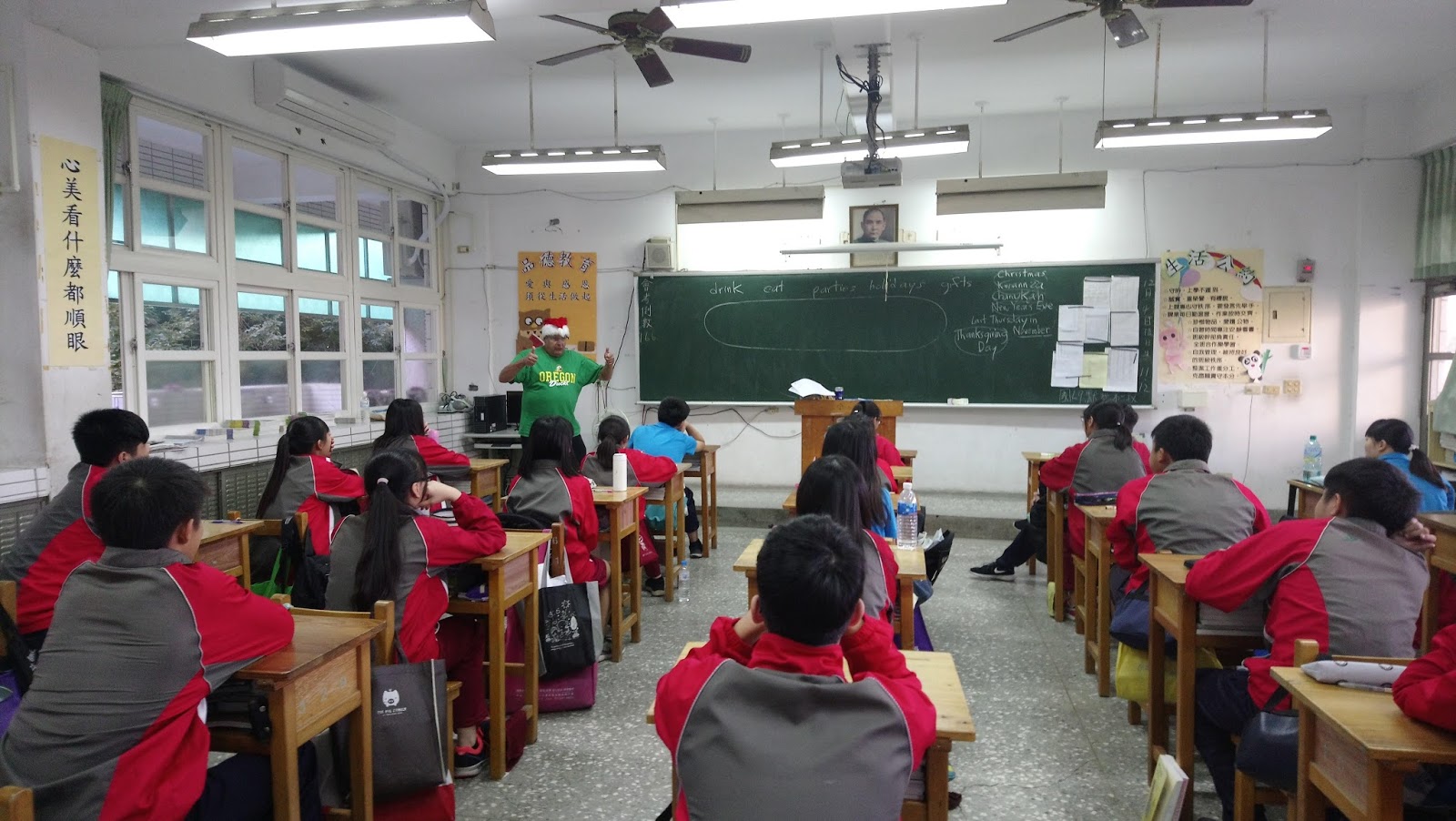
I live in Taichung and ride the bicycle to the Shengang Middle School for 7 graders conversation practice. The weather is sunny and cool; in the 60's. Since it is holiday season in America, every middle school wants me to do a Christmas program, including Shengang. So I give the children the full scope of festivities between Thanksgiving and New Year. I slide in with a brainstorm on the Winter Holiday Season with a racetrack matrix. The 8 graders begin a re-telling of an O Henry story, “Gift of the Magi” for the holiday season before Christmas Day; it would be fun doing it. It was the opening salvo in delightful visits to five Central Taiwan middle schools, one of them twice, with English as a Foreign Language programs to bring fluency and good cheer.  

 December 12th was the first night of Hanukkah in Taiwan. We light the candles in Asia before The Middle World, Europe, or America gets around to it. When I am asked to give a presentation here to school children about Christmas, I talk about "Winter Holidays" and Christmas shrinks to one night and day, but it’s a nine day holiday that most American children (and teachers) enjoy away from school. For the eight nights of Hanukkah, we light candles. The month between Thanksgiving Day and New Years Day is a celebration for all, no matter how many Santa songs they play on the radio. The candles glow to show that miracles are real; Kwanzaa candles glow, too, for the seven virtues that helped the survivors of slavery cope with this holiday.  Charles Dickens knew how tough it was. 
     On December 4, we were driven to Yunlin for three classes in Tse-Tong Middle School; there would be three more classes the following week. Forty-five minutes was just enough time to brainstorm December festivities with  reported speech culminating in board contests. There would be no reading, songs or handouts, well, maybe a short song played from my smartphone onto a Bluetooth mini-speaker: “We wish you a Merry Christmas.” I couldn't rely on audio-visual equipment in rural classrooms. 
     The one 7th grade and two 9th grade classes went very well. The rudimentary cooperative learning experience, because of  antiquated EFL teaching methods, not any worse than in a big city, was all the students could muster; the students had never been called on to participate in comprehensible discussion before. In the lower level, it was impossible; they didn’t know basic vocabulary, so I taught them the pattern and lit their fire to caucus and then come up to the board with responses to my cues. The first few rounds they sat in their seats. The first 9th graders were better. I heard their teacher say she was disappointed that they couldn’t use past tense she had taught. The method I used was a shock to the students who had never practiced it. 
In the third class of "gifted students" I didn't go into reported speech; instead we brainstormed ten notions about  December festivities; food, drink, Thanksgiving,  holidays, gifts, party, New Year’s Eve, Hanukkah, climate, and outdoor activities. I drew a race track matrix on the board. The class was divided into five teams by row. It was a relay race to write one example connected to each notion. It was a bit chaotic because the board space was too small and there was a raised dais and podium that obstructed; teachers in Taiwan usually lecture and students remain seated. In the end, most students who hadn't prepared  copied from each other. 
In  six classes at Tse-Tong, I demonstrated different contest matrix. Their EFL teachers stood by. My hope was they could benefit from employing the fun approaches I used to do revision in EFL class. What I like best about teaching EFL is finding new ways to teach.


On December 16th, we returned to the middle school in Yunlin for three more seasonal enrichment classes. The first two classes used cooperative learning; first with the tag-team board re-telling of “Gift of the Magi” and  a question and answer board contest about my telling of Dickens' “A Christmas Carol.” The third class was not a “gifted” class as the first two were identified to me as; what that means is the principal of the school had given up on them and saddled them with an ineffective teacher, or maybe the teacher was being punished while the children suffered with chaos his non-discipline. 
While brain-storming December Holidays” went well with many children participating verbally, they ignored my suggestion to copy down the ideas we shared from the board and weren’t prepared for the race matrix contest that followed. Most of the six row-team’s responses were inappropriate and flippant but I didn’t let that dampen the outcome; I merely erased the waste and let the students caucus for a revision. The second round responses were better but the lack of discipline was detracting from the outcome. Their teacher remained docile in the back of the room and didn’t help; instead he loudly said the children didn’t know enough English the copy the six words: “In December, there are many holidays.” After the morning program  in Yunlin, the publisher drove us  home. I rested for an hour, and then drove to the regular class in Shengang at 4pm; I was too exhausted to ride the bike. 
The 8th grade 
evening class at Shengang started with the same December Holidays brainstorming activity As I had done in Yunlin, I took out a Menorah the rabbi in Taipei had gifted me, put on my yarmulke, and lit four candles with singing blessings in Hebrew. The children had never heard Hebrew before and were silent with reverence.
The brainstorming contest went well but I wanted the children to remember the kids who had nothing. I segued into the “Haitian Family Budget” cooperative learning activity. Each group was now a poor Haitian family trying to make ends with the little money they were paid. The children brainstormed items to buy from an actual  shopping list. I told them that the goal of the activity was to live and not die of malnutrition. The next week they would give presentation of their family budgets. If there was time, they would then  hear a holiday story to retell or answer questions about. I would do the brainstorm activity with the 7th graders the following Wednesday but leave much more time for the lower level class. A retelling activity would have to wait.  
 I still didn't know how I would handle a 45 minute presentation for 300 students at the  Dec. 21 event and allow for  participation for prizes. I couldn't do a brainstorm,  retelling, or question answering  as I had done in Yunlin. I could do a power point presentation but how could I incorporate participation. I started a PPT I was calling “Season’s Greetings” and would figure out how to use it later.


It was a unique presentation at Caotun Middle School in Nantou on December 21. It was the first time I had done enrichment in any public school in Nantou however I did present “Judaism; My Faith” in Amber Zhang’s class at the college there. Typically, I was asked to do a Christmas program for the student body; 45 minutes to 300 students. I decided to make a power point presentation that I call “Season’s Greetings” that puts Christmas day in its place among the other holidays celebrated in the U.S. and Canada.

The big challenge I had with this presentation was figuring out how to keep all the students involved while handing out 20 little gifts the publish had put into separate plastic bags. I knew I wanted to ask the children questions to see if they understood the basics about the seasonal holidays but I couldn’t have board or panel contests as I had with Shengang and Yunlin classes; this group was too large. I didn’t want anybody moving around creating chaos. My solution was to add numbers and letters to 8 of the 10 slides dealing with holidays, regional climate, outdoor activities, Thanksgiving, Hanukkah, Christmas, Kwanzaa, and New Year’s; the first slide was the title slide and the last was the video and lyrics of “Ding Dong” by George Harrison that I would save for a sing-along at the end if there was time. It worked like a charm. I went through  the slides and commented on each one; the foods, festivities, customs, commemoration, and activities. I pointed out the connection between the photos and the smart art cycle matrix within. Speaking in Mandarin I told the ten classes of twenty plus students what I would be doing and warned them there would be a contest for gifts when I went through the slide show the                                             second time. I randomly called the class sitting on the gymnasium floor to their feet and told them to raise a hand if they knew an answer to my question about the slide on display. They didn’t have to say the difficult words; only the letter associated with the photo or the number of the caption. It worked out so well that I had five minutes enough to play and sing the “Ding Dong” song. I told the classes that the class that sang the heartiest would win the remaining five gifts. One slightly boisterous class won and the event concluded on time with everybody happy. 

What could be better on Christmas morning than listening over a hundred middle school children in twelve groups singing and dancing to English language songs, none of them about Christmas? If it weren't for the plastic LED lit Santa plaque affixed to the stand of the Sun Yat-Sen statue near the entrance, you wouldn't have known it was Christmas Day. 
We went to the Jianguo Middle School English Choral Competition where I was to be one of five judges, the only native English speaker. Only the teacher to my left could speak with me. We chatted between performances and it was quite pleasant. The ninety minute drive from Taichung at 6:30 am was worth getting up early for. 
"Fight Song" 1st place
 "My Songs Know What You Did In the Dark" 4th place
Even though many of the songs were song off-key, you could tell that the children had been practicing hard for many weeks on pronunciation, singing, and choreography. So what if the phrasing wasn't smooth? Who cared if the words were mispronounced?  It didn't matter that some songs were inappropriate love songs between a man and a woman in which a dozen boys hugged each other while a dozen girls did the same. It was brotherly love just the same. Who cared that "I Will Follow Him," the "Little" Peggy March anthem of girlfriends worshiping boys was sung with "Sister Act" gusto to Jesus? I held my mouth in the face of the exposure since then of pedophilia in the church; the song was appropriate after all. I had a hell of a time listening to all the selections and the groups I picked to win all one, though not in the places I suggested. My first place pick, "My Songs Know What You Did In the Dark,"  finished fourth; they were the largest ensemble, sang fluently on-key, had good rhythm, stereo effect, and had the most interesting and appropriate lyrics, but there was corruption afoot. Unbeknownst to me, my second place pick, the one that sang "Fight Song" well, won first place instead  because they were the music class and two of the judges were their teachers. 


 On
the morning of Wednesday, December 27 , I drove to the southern tip of Taichung to a school I had done enrichment at before. I was to be one of two judges for a recitation contest. The children had been given three paragraphs in class. They would be randomly asked to read one of them for pronunciation, intonation, loudness, and stage presence. Each was about 80 words long;  they had a minute to complete.  Twenty-two students  participated. I left before I knew who won; three or four were better than the rest It was a silly in-school contest that I enjoyed doing. 

  In the evening, I returned to my regular class at Shengang. The entire 90 minutes  was dedicated to “The Gift of the Magi” and its group retelling. The 7 graders listened carefully, caucused in teams for fifteen minutes, and then relayed putting chronological details on the board.  I read each paragraph and drew red circles around the errors I saw. Once the initial round of 10+ details was complete, I assigned each of the five members a role to return and correct errors in grammar, spelling, details, subject-verb agreement, and tense; they were told to use present tense for a story summary. I then asked for volunteers to read their own summary but there weren’t any so I randomly picked children to do so. I asked the children to copy their group’s revised paragraphs but few of them did. I hope something sticks in their mind from this activity.                                                           This time of year in Taiwan, I remember my last class  at my bushiban in Taipei many years ago. I knew I would have to be returning to New York City, but I couldn't tell anyone. I taught “I’ll Be Home for Christmas,” a happy holiday song, but I was crying in my heart. I broke down after my last class; the  owners knew I didn’t want to leave. Twenty-three years later, I returned to retire, but teaching will always be in my blood. It is such a gas visiting children around Central Taiwan  to share English language cheer and wish them all "Season's Greetings."